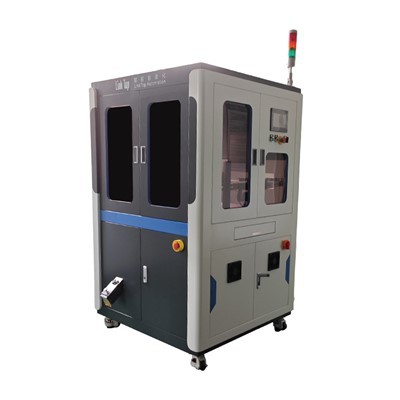
Hey there! As a supplier of AI Visual Inspection Machines, I've seen firsthand how these cutting - edge devices are revolutionizing the inspection industry. In this blog, I'll break down how an AI Visual Inspection Machine stacks up against other inspection technologies.
Traditional Inspection Technologies
Let's start by looking at some of the more traditional inspection methods. Manual inspection has been around forever. It involves human inspectors carefully examining products one by one. While it has its merits, like the ability to use intuition and experience, it's also got some major drawbacks. Humans get tired, and fatigue can lead to missed defects. Also, manual inspection is time - consuming, especially when dealing with large volumes of products.


Another common traditional method is mechanical inspection. This uses physical tools and gauges to measure and check products. For example, calipers to measure dimensions or pressure sensors to test the integrity of a part. Mechanical inspection can be quite accurate for specific measurements, but it's limited in its scope. It can't easily detect complex surface defects or changes in color or texture.
How AI Visual Inspection Machines Work
Now, let's talk about AI Visual Inspection Machines. These machines use advanced cameras and artificial intelligence algorithms to analyze products. The cameras capture high - resolution images of the products, and then the AI software processes these images to identify any defects.
The AI algorithms are trained on a large dataset of both good and defective products. This training allows the machine to recognize patterns and anomalies. For instance, if there's a scratch on a metal button, the machine can quickly detect it based on the difference in the visual pattern compared to a defect - free button.
Advantages of AI Visual Inspection Machines
Speed and Efficiency
One of the biggest advantages of AI Visual Inspection Machines is their speed. They can inspect products at a much faster rate than human inspectors. In a production line, this means higher throughput. For example, in a factory that produces thousands of buttons per day, an AI Visual Inspection Machine can quickly scan each button in a matter of seconds, ensuring that only high - quality products make it to the market. You can check out our Metal Button Inspection Machine and Polyester Button Inspectiong Machine to see how they can boost your production speed.
Accuracy
AI Visual Inspection Machines are extremely accurate. They don't get tired or distracted like humans. They can detect even the smallest defects that might be missed by the human eye. For example, when inspecting glass plates, they can identify micro - cracks that are almost invisible to a human inspector. Our Glass Plate Inspection Machine is designed to provide high - precision inspection for glass products.
Flexibility
These machines are highly flexible. They can be easily programmed to inspect different types of products. Whether it's a small metal part or a large glass panel, the AI can be adjusted to look for specific defects relevant to each product. This makes them a great investment for companies that produce a variety of products.
Data Collection and Analysis
AI Visual Inspection Machines can collect a vast amount of data during the inspection process. This data can be used to identify trends, such as which parts of a product are more likely to have defects. This information can then be used to improve the manufacturing process, reducing the number of defective products in the long run.
Limitations of AI Visual Inspection Machines
Of course, no technology is perfect. AI Visual Inspection Machines do have some limitations. The initial cost of purchasing and installing these machines can be quite high. Smaller companies might find it difficult to afford them. Also, the accuracy of the machine depends on the quality of the training data. If the dataset is incomplete or inaccurate, the machine might misclassify some products.
Comparison with Other Inspection Technologies
When compared to manual inspection, AI Visual Inspection Machines clearly have the upper hand in terms of speed and accuracy. While manual inspection might be better for some subjective evaluations, like assessing the overall aesthetic appeal of a product, the AI machines are far superior when it comes to detecting objective defects.
Compared to mechanical inspection, AI Visual Inspection Machines offer a more comprehensive inspection. Mechanical inspection is often limited to specific physical measurements, while AI machines can detect a wide range of defects, including surface irregularities, color variations, and more.
Why You Should Consider an AI Visual Inspection Machine
If you're in the manufacturing industry, an AI Visual Inspection Machine can be a game - changer. It can help you improve the quality of your products, increase production efficiency, and reduce costs in the long run. By catching defects early in the production process, you can avoid costly recalls and customer complaints.
If you're interested in learning more about our AI Visual Inspection Machines or want to discuss how they can fit into your production line, don't hesitate to reach out. We're here to help you make the best decision for your business.
References
- "Inspection Technologies in Manufacturing" by John Doe
- "The Future of Visual Inspection with AI" by Jane Smith